
Searching for the Truth

CBS’s 60-Minutes was planning to run a segment on their show about CECOT and what they deemed  “brutal and tortuous conditions.” But then the segment was pulled from the show in the US, reportedly due to pressure from the Trump Administration. Apparently, 60-Minutes in Canada didn’t get the memo, and the segment was aired in Canada. It then made it to social media, and many people in the US, along with independent media outlets saw the episode. Supposedly it has since been removed from YouTube, citing copyright infringement by CBS, but I haven’t verified that fact.

From what I understand the episode was chilling, but the contents of that episode is not really what this blog post is about.

This current bending of the knee by CBS is another example of how the free and open press in our country—something that is supposed to be enshrined in our First Amendment—is eroding.  Our traditional media outlets are looking far different from when I was studying journalism in college, a decade before Reagan killed the Fairness Doctrine.

I have been writing for most of my life. My first novel at age 14. In high school, I was on the school paper, and its co-editor my senior year.  I studied journalism in college. At age 19, I wrote a screen play for one of my classes, which I later made into a book. At age 21, I wrote and produced a TV documentary for my senior project, that was aired on an educational TV channel in Southern California. In my thirties, I was the editor and publisher of a publication serving the communities of Wrightwood, Phelan, and Pinion Hills, California, called Mountain/Hi-Desert Guide, for about six years. 

In my forties, I wrote and self-published a book on local history, that I believe is still being sold in the Havasu Museum, and I wrote Lessons, an unconventional love story that I self-published over a decade later, and it was eventually made into a five book series, and its audio rights sold to Dreamscape Media.

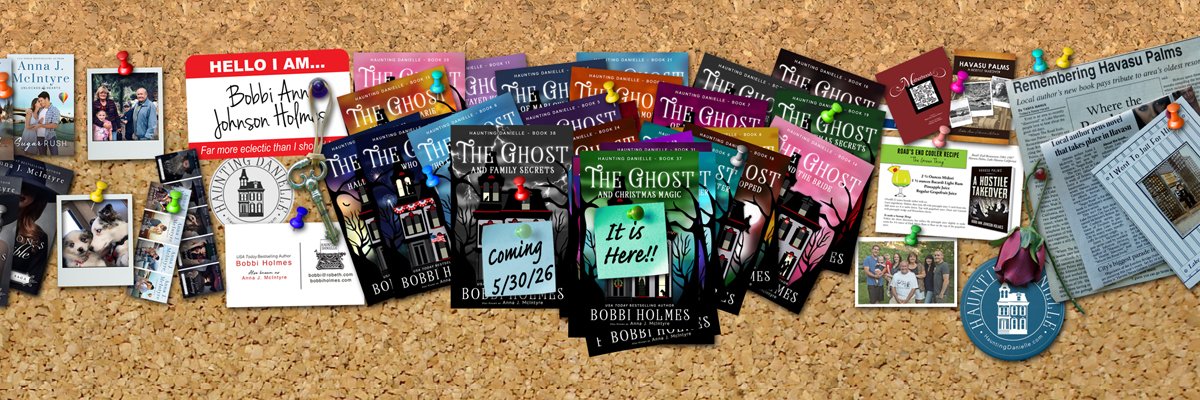
These days I am known—by people who know me and I am not claiming to be some well-known author, I’m not—for the Haunting Danielle series, which currently has 37 books, and got me on the USA Today Bestseller list.

My point being—and yes, I do have a point—since I first started writing I have moved from fiction to non-fiction—and back again.

Those who took English with me in high school might remember I was probably the only classmate who looked forward to doing the term paper. I LOVED doing term papers. Seriously. I loved the research, which back then, meant visiting libraries and conducting interviews. We didn’t have the internet yet, and I was going to school in the remote community of Lake Havasu City, Arizona, so library access was limited.

When I was editor of Mountain/Hi-Desert Guide I regularly interviewed local people of interest, local politicians, and even got representatives from the county government and sheriff’s department to submit monthly columns to the publication. 

But my favorite was researching and writing about local history. Sometimes during my research, I would end up dispelling an accepted story on local history and set the record straight. I was somewhat obsessive about drilling down to find the source of the source. 

This was in the 1980s, and we still didn’t have the internet in Wrightwood. I often drove off the hill to visit some of the larger libraries and often visited the California Room in one of those libraries.

After one such visit and continually finding conflicting information from what appeared to be reputable sources, I asked one of the research librarians a question. 

The question: When you keep coming up with different stories about the same event, how do you know which one to use?

Her reply: Which ever version has been told the most frequently.

Her answer troubled me. It wasn’t what I expected—and it’s entirely possible that if I had asked another librarian the same question, they would have given me a different answer. But this is the response that I was given.

I find it especially troubling considering our current administration, especially with the pressure it’s exerting on corporate media outlets.

I keep thinking about the strategy used by many in this administration—if you repeat a lie enough, it will eventually be accepted as truth.

That lie ends up filling all the space, and suddenly we believe what they want us to believe.

We all need to be cognizant of how AI, coupled with our addiction to social media, makes it easier for someone with an agenda to overwhelm us with a false narrative—eventually replacing the truth.

And what makes this scarier—is when the folks with the agenda have the power to lock down the entities holding evidence of the truth.  Or in simpler terms, re-writing history.

(Photo: Bobbi Holmes. Early days of Mountain/Hi-Desert Guide, its first office in the basement, before moving to its downtown office.)

Christmas Family Traditions and the Pfeffernüsse Cookie

In my most recent Haunting Danielle book, The Ghost and Christmas Magic, I write a lot about family Christmas traditions. Many Christmas traditions are food traditions, like what foods are served on Christmas Eve and Christmas night, or special treats. Some of the food traditions from my family I’ve introduced to the Haunting Danielle world.

In our family, my Grandma Madeline made things like Tollhouse Chocolate Chip Cookies, Chocolate Drop Cookies, Chex Mix, and cheese balls every Christmas. Dad made his fudge—a recipe he developed himself. When my kids were little, our go-to Christmas cookie was the Magic Bar cookie, which was easy to make for a busy young mom, and I thought tasted even better than chocolate chip.  And then there was Grandma Hilda’s infamous Feffernut Cookie.

Both of my grandmothers were known for being excellent cooks. In my mother’s family, the Feffernut cookie was a Christmas family tradition. Mom and my sister loved them, dad called them dog biscuits.

As a child, I didn’t like them because they weren’t chocolate. I probably tried them when I was little—although I don’t remember—I just remembered they weren’t chocolate, and I was a picky eater so for me, when I opened a cookie tin and saw Feffernut cookies, I saw disappointment.

When Grandma Hilda—and whoever helped her, probably my aunt Margaret—make the cookies, they would make a lot and store them in pillowcases.  Grandma didn’t seem to take offence at Dad’s critique. 

I was pretty young when Grandma had to hang up her apron. By this time she had glaucoma and was considered legally blind yet had some vision out of one eye. My Aunt Margaret, mom’s older sister, took over the task of making the Feffernut cookies. Cooking was never Mom’s thing, but she loved the Feffernut cookie, so she appreciated the tin of cookies Margaret sent each year.

Despite knowing my family was not a Feffernut fan, Aunt Margaret would send my family a tin of homemade cookies each Christmas, with some of them being the “dog biscuits.” As it turned out, my kids and husband shared Dad’s view of the cookie. We’d give Mom the cookies, even though she had a tin of her own. 

Now fast forward many years, and Aunt Margaret, like her mother before her, had to hang up her apron. My sister, Lynn, who always made the absolute best chocolate chip cookies, began making Feffernut cookies every Christmas, something Mom appreciated.

Then something crazy happened…I tried one of my sister’s Feffernut cookies. And I liked it…I really liked it. For one thing, it was not dry like Aunt Margaret’s (sorry Auntie) and I can’t say how it compares to Grandma Hilda’s because that was so long ago. Even my husband likes my sister’s Feffernut cookies.

Last year Lynn didn’t send us any. I suspect because Mom had passed months before that Christmas, and that’s who Lynn usually made them for. This year, when Lynn asked what I wanted for Christmas, I said Feffernut cookies. 

Yesterday my sister’s Christmas package arrived, it included the requested cookies—and they are super yummy.

But are they really called Feffernut? When I was growing up, I heard them called Feffernut—and Peppernut. Yet they are actually Pfeffernüsse cookies, a small round German spice cookie popular during the holidays. From what I understand, this is a cookie Grandma Hilda made with her mother, and I assume her sisters.

While Grandma Hilda’s father was born in Norway, her mother, Louisa Sontag, was born in Wisconsin in 1872. Louisa’s father, Jacob Sontag, was born in Germany in 1846 and immigrated to the USA around the age of six. Louisa’s mother, Margaretha Frisch, was born on the ship when her parents were immigrating from Switzerland, in 1850. 

Margaretha Frish had ten children, and died when Lousia was sixteen, at the age of thirty-eight. Jacob remarried three times after his first wife’s death. While I am not sure about the statuses of the subsequent marriages—did they divorce or die—I know his mother, Barbara Heinrich, outlived Jacob. 

Barbara Heinrich, Jacob’s mother, Louisa’s grandmother, and Hilda’s great grandmother, died when my grandma Hilda was around eleven years old. I remember hearing stories about how when Grandma Hilda was a little girl, she knew how to speak German. I suspect she learned from her Great-Grandma Barbara, and I imagine the Pfeffernüsse cookie was a tradition passed down from Barbara.

While Grandma never spoke German when I knew her—and I understood she no longer remembered how to speak it—she still knew how to make the Pfeffernüsse cookie, and that tradition has been passed down to Barbara’s Great-Great-Great Granddaughter, my sister Lynn.

Grandma Hilda’s Peppernut Cookie Recipe

  • 2 cups shortening
  • 1 quart light molasses
  • 1 teaspoon salt
  • 2 cups light brown sugar
  • 4 eggs (beaten)
  • 2 teaspoons baking soda (dissolved in a little warm water)
  • 2 cups chopped walnuts ( not chopped too fine)
  • 1/2 teaspoon ground cloves
  • 2 teaspoons cinnamon
  • 2 tablespoons pepper nut seeds (equal amounts of cardamon, anise and
  • coriander seeds ground together)
  • Walnut halves for topping cookies (Optional)
  • Flour
  • In large pot melt shortening, add molasses, salt and brown sugar. Bring to near boil, remove from heat and allow to cool. While warm (not hot) add eggs, stir. Add remaining ingredients, blend well. Add enough flour to make a stiff batter that can be stirred with a large spoon. Chill. Roll and slice. Place cookie rounds on cookie sheet, top with walnut and bake for 15 minutes at 300º.

When I realized I was a real author…

It’s been ten days since I released The Ghost and Christmas Magic, the 37th book in my Haunting Danielle series. It is also the fourth Christmas themed book in the series. I am happy to report, thus far it has been well received by my readers. 

When I first started the Haunting Danielle series I wrote four books a year. That wasn’t something I planned in the beginning. As I have mentioned in previous blog posts, I never intended for the series to go on this long, it just sort of happened. Readers asked for more books, I had story ideas, and I enjoyed writing the books—so I wrote.

 I did learn early on that pre-orders were an effective marketing strategy, so I started putting the eBook formats on pre-order at Amazon, and then later at other venues. Back then, Amazon offered a limited window for pre-orders, so basically, I needed to put out a book every 90 days if I wanted to utilize the pre-order at Amazon—which brought me to four books a year.

After Amazon removed the maximum 90 day preorder, I began rethinking the four books a year. While I love writing, life is short and I am getting older—much older—so I felt it was best to maybe write three books a year—then two. Writing two books a year gives me more time to spend with family and friends, in the garden, or exploring new recipes. This past summer my husband and I took a car trip down the coast, visiting with my daughter and grandchildren, my sister and her family, and two of our closest friends, Carolyn and Dave. Then in October, we spent some time on the Oregon coast with our son and daughter-in-law, at an Airbnb.   

Anyway, as to now….

I don’t intend to start my next Haunting Danielle book for a couple of months. So, what are my plans? Currently, we’re in the rainy season up here in Oregon. With the shorter days (sun currently setting by 4:30 p.m.) and wet roads, we won’t be out exploring.

Do I intend to winterize my greenhouse? That’s something I should have done before my poor basil plant (which had been thriving in the greenhouse) would have benefited from, since it has since been attacked by mold (too damp obviously) and I must throw the poor thing in the compost pile.

Will I spend time in the kitchen figuring out how Oma Head (whose divinity inspired Marie’s) made such amazing divinity?

Nope, it seems I am starting a new book—inspired by my recent 71st birthday. Had you asked me a month ago if I would be starting a new book during my Haunting Danielle writing hiatus I would have thought that a silly question. But silly question or not, it is exactly what I am doing.

I’m writing the book more for myself—more so than my previous books. I already have a title—one that is not chiseled in stone and may change. The title? An Author’s Journey.

The catalyst behind this manuscript: turning seventy-one along with countless Indi-author TikTok videos I’ve consumed in the last few years.  Let me explain…

Self-publishing has been around for years. Notable authors such as Mark Twain and John Grishman started with self-publishing. I even self-published Where the Road End’s, Havasu Palms, Recipes and Remembrances, thirty years ago. 

Despite some of those notable authors I mentioned, self-publishing has typically taken on a negative connotation. Those weren’t real authors. Many self-published authors used what we call vanity publishers, publishers who charge the author for things like printing, editing and cover design, things a trade publisher typically pays for.

Back when I was in real estate my broker would sometimes mention I was an author when introducing me, which always made me uncomfortable, leaving me feeling like an imposter. I had written Where the Road End’s, Havasu Palms, Recipes and Remembrances for specific reasons, and one of them was not to be able to tell people I was an author, because quite frankly, I didn’t see myself as one back then.

Now fast forward to the first decade of the twenty-first century and Amazon’s launch of Kindle Direct Publishing (KDP), a platform giving writers an easy way to self-publish. eBooks readers had been out a few years and were starting to get popular. They also needed more content.

KDP gave writers a way to not just side-step traditional publishers, but to reach readers in a way self-published authors had never been able to do before. And it was free. 

Self-publishing was still seen negatively—yet with successes of new Indi-authors, that perception began to change. While come still see self-publishing negatively, the perception of self-publishing has drastically shifted since the advent of eBook readers.  

Now, back to the catalyst behind my current manuscript. I self-published my first book on KDP around fourteen years ago.  When I watch videos about indie authors, most of whom started their author’s journey within the same fourteen year timespan, the general opinion is that very few people can ever make a living from writing.

At first, I disagreed with this contention. I have a number of author friends who do support themselves primarily from their author income, including myself. I wondered why some of the authors who had been doing this for as long as me weren’t as far along on the game board, so to speak. Had I just been extremely lucky? 

Then, right around my recent birthday, as I was processing the fact I was about to turn seventy-freaking-one, reality smacked me.  We hadn’t started at the same time—all those talented and much younger authors who I had seen on TikTok. Sure, I might have uploaded my first manuscript to KDP within a few years as them, the fact was, I’d started my author journey decades earlier. 

Twenty-four years ago, when my broker was telling people I was an author, and I was thinking No, I’m not, I had forgotten about the manuscript sitting in my drawer (that would later be published, made into a book series, and its audiobook rights bought by Dreamscape Media); I had also forgotten about the documentary I wrote and produced my senior year of college, that was shown through the Santa Ana school district public television station; I had forgotten about the finished screen play sitting in my garage that I wrote for my film writing class, during my third year of college; I had also forgotten about the first book I wrote during the summer when I was fourteen. Yet the biggest forget was probably Mountain/Hi-Desert Guide, the monthly community magazine I had published in the 1980s, along with Wrightwood Magazine.

My point being, I had been doing this authoring stuff for my entire life. It wasn’t just the last fourteen years; it’s been almost sixty years.  While I haven’t reached the fame as some authors, that’s okay. It’s been a fulfilling journey, and I am exactly where I want to be in life. How many people can say they have achieved their childhood dream?

An Author’s Journey is part letter to aspiring authors and part memoir to my family. I’ll be writing it between book 37 and 38 in my Haunting Danielle series and may have to put it on pause and return to it after I write and publish book 38.  Will anyone read it? Will anyone want to read it? I don’t know, but to be honest, either way is okay as I’m primarily writing it for myself.